
2026: How AI Reshaped the Way People Discover Apps
Introduction: The Year “Finding an App” Changed for Good
2026 was the year the “entry point” to finding an app stopped being just one thing.
On top of the store’s search bar, apps could now be found inside AI chat tools like ChatGPT and Gemini, and even through new AI-agent mechanisms like Google’s Connected Apps Platform (a system that lets conversational AI such as ChatGPT or Gemini call an app’s functions directly, without the user ever opening the app). Throughout the year, the places where an app could be discovered kept multiplying.
In a survey of 1,000 US adults conducted by AppTweak in August 2026, 58% said they had already used an AI assistant to search for or choose an app. For app operators, this was the year it became impossible to ignore not just App Store Optimization (ASO), but also the question of how AI finds and presents your app.
This article is written for marketers and business owners who want a clear overview of their app’s ASO and AIO readiness. You don’t need to be running dedicated ASO tools to follow along. We’ll walk through what actually happened on the platform side in 2026, check the data on what’s really driving results, and lay out what Japanese app operators should act on as the year closes.
Conclusion
What happened in 2026 can be summed up in two main points.
First, Apple, Google, and OpenAI — the three major platforms — each spent the year building out their own version of “an entry point where AI introduces your app.” AI moved into the stores themselves (Ask Play, Play in Gemini), new AI entry points appeared outside the stores (ChatGPT’s Business Hub, Connected Apps Platform), and even ASO tools gained a way to hand data straight to AI (MCP).
Second, despite all that, what ultimately decided whether an app got chosen was still the store’s basic information — its description, reviews, and ratings. 47.5% of the sources AI cites when recommending an app are the store listing itself, and 59% of consumers still check reviews before downloading, even after AI recommended the app.
In other words, 2026 was both “the year AI entry points multiplied” and, paradoxically, “the year ASO fundamentals mattered more than ever.” At Standarrow, we help app businesses build on a foundation of App Store Optimization (ASO) while also preparing the information AI needs to recommend them correctly (AIO/AEO). Start with our free AIO Score Diagnostic to see how your app looks to AI today.
1. AI Moved Into the Stores Themselves
Throughout 2026, both the App Store and Google Play rolled out one AI-powered feature after another, built directly into the store experience.
| Date | Platform | Feature | What it does |
|---|---|---|---|
| Sept 29 | App Store | Expanded Siri App Intents | In iOS 27, Siri can now call an app’s functions directly |
| Oct 5 | App Store | Asset Library | Creative assets can be pre-reviewed separately from app updates |
| Oct 13 | Google Play | Ask Play comparisons | Multiple apps can be compared side by side via natural-language questions |
| Oct 13 | Google Play | Play in Gemini | Apps can be recommended and installed in the middle of a Gemini conversation |
| Oct 13 | Google Play | Game Finder | Suggests games using data from over 2 billion players |
According to an announcement by Sam Bright, VP of Google Play, Play in Gemini drove over 6 million installs in its first two months (May 19 – July 31).
Each of these changes looks small on its own, but they share a common thread: it’s no longer just the store’s search bar that matters — the AI features built inside the store (Ask Play, Siri App Intents, and the rest) are now shaping how an app gets discovered in the first place.
2. New AI Entry Points Opened Up Outside the Stores
It wasn’t just the stores themselves — AI chat became a full-fledged entry point to apps in its own right.
| Date | Company | Initiative | What it does |
|---|---|---|---|
| Sept 29 | OpenAI | Marketplace | Announced at DevDay: app experiences that run entirely inside ChatGPT. 1.2 billion weekly users, 30+ launch partners (Adobe, Figma, Salesforce, and others) |
| Oct 28 | Connected Apps Platform | A preview that lets app functionality plug into both Google Search and the Gemini app. 50+ companies already connected, including Adobe, Experian, Peloton, and Calm | |
| Nov 10 | OpenAI | Business Hub | Beta launch letting companies see how often and how they’re mentioned and clicked on within ChatGPT |
All three share the same underlying idea: let the AI complete the task itself, instead of sending the user off to download an app. Connected Apps Platform works by having developers connect either through an MCP (Model Context Protocol — a shared standard that lets AI access an app’s data and functions) server, or through Android’s AppFunctions API. It’s built on the same thinking as OpenAI’s Marketplace.
For now, these remain largely US-based, invite-only betas, and Japanese apps aren’t directly in scope yet. But the broader trend — AI platforms building their own distribution networks outside the traditional stores — is worth keeping on your radar starting now.
3. ASO Tools Themselves Became “Just Ask the AI”
It’s not only the platforms — ASO tools have started connecting directly to AI assistants too.
- AppFollow (September): Rolled out an MCP feature early, letting Claude or ChatGPT access a company’s ASO data directly.
- AppTweak (November 10): Launched “AppTweak MCP,” built into every ASO plan at no extra cost, giving AI-based access to data on 17 million keywords and 6 million apps.
Both are read-only — nothing gets changed through AI access. You can simply ask, in plain language, “Which keywords dropped in ranking this week, and why?” and get an answer without ever opening a dashboard. With two major ASO vendors rolling out similar free, built-in features within about two months of each other, ASO data is quickly moving from “something you look at on a dashboard” to “something you just ask AI about” — industry-wide.
That said, what MCP provides is only access to raw data. Deciding “which keywords to target” or “what to improve” from that data, and actually acting on it, still requires real expertise. If anything, now that the data itself is easier to pull, the value of interpreting those numbers and turning them into action has only grown.
4. AI Still Looks at “the Store Basics” — and That Hasn’t Changed
While the platform-level changes grabbed headlines, several studies published in 2026 quietly pointed to the same underlying truth: what actually decides an app’s fate.
AppTweak (May 2026, analyzing 125,000+ US ChatGPT responses): 47.5% of the sources AI cites when recommending an app are the store listing itself (37.6% from the App Store, 9.5% from Google Play). Your store description is, quite literally, becoming AI’s evidence.
AppTweak (August 2026, 1,000 US adults): 58% have used AI to search for an app at some point, but the single most common first trigger is still in-store search (20%), compared to around 10% for AI. AI is one entry point among several — not yet the dominant one.
Same survey: Even after an AI recommendation, 59% still check reviews and ratings before downloading, and only 16% download immediately. The final call is still made using store information.
Obelisk Club (October 2026, analyzing 178,637 apps across 9 countries): About 1 in 10 top-charting apps now use the word “AI” in their description — rising to over 40% for photo and design apps. Simply writing “AI” no longer sets you apart.
Put these four findings together, and a single thread emerges: more entry points exist now, but what AI looks at, and what people ultimately decide with, both still come down to the same thing — your store description and your reviews. And since slapping “AI-powered” on your listing no longer differentiates you, how specifically you write that description is what will actually separate you from the pack.
5. The Bar for Honest Disclosure Is Now the Same for Humans and AI
“Disclosure” here doesn’t just mean the description users read in the store. It also includes the functionality you declare to the platform during app review. As AI started reading — and in some cases directly calling — app functionality, the rules around this broader sense of “accurate disclosure” began to take concrete shape.
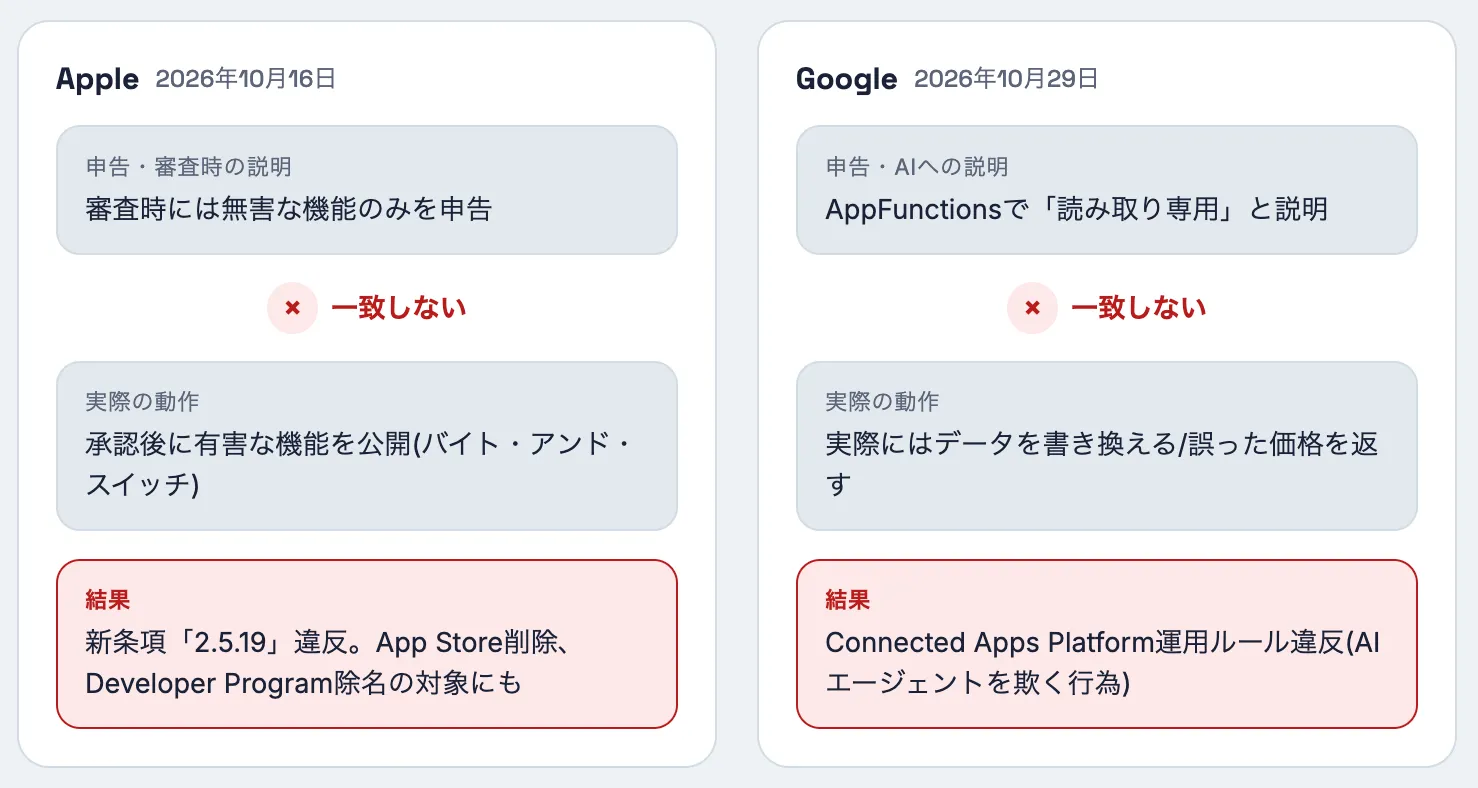
Apple (October 16): Revised its App Review Guidelines to add new clause 2.5.19, banning undisclosed hidden functionality. So-called “bait-and-switch” apps — ones that appear harmless during review, then ship harmful functionality once approved — now risk not just removal from the App Store, but expulsion from the Developer Program entirely. This targets a specific kind of “disclosure inaccuracy”: a mismatch between what was declared at review time and what the app actually does.
Google (October 29): As part of Connected Apps Platform’s operating rules, Google formalized a policy for AppFunctions — the mechanism apps use to expose functionality to AI agents — strictly prohibiting “deceiving or manipulating AI agents, circumventing security controls, or interfering with other apps.” Specific examples cited include describing something as “read-only” while it actually modifies data, returning incorrect prices, or claiming to have functionality that doesn’t actually exist.
What both have in common: the bar for honesty doesn’t change just because the reader switched from a human to an AI. Very few Japanese apps currently expose functionality to AI agents, but the underlying habit — auditing your store description for exaggerated claims — is something you can start applying today regardless.
6. 2026 Wrap-Up: What Japanese App Operators Can Do Right Now
Given everything above, the takeaway isn’t “switch everything over to AI.” It comes down to this: get your store fundamentals solid, so that the same information holds up at every new AI entry point too.
① Prioritize fixing the store listing basics Revisit your title, keywords, screenshots, and description first. AppTweak’s research shows store metadata accounts for 47.5% of what AI references — the foundation for AI readiness is still, at its core, basic ASO.
② Audit your screenshots and description for honesty As Apple’s bait-and-switch crackdown and Google’s AppFunctions anti-deception rule both show, misrepresenting functionality after passing review is now easier to catch — and comes with steeper penalties — in the AI era.
③ Get ready to track trends in AI-driven traffic, even without a clean measurement tool yet Right now, there’s no official way to isolate traffic from individual AI sources like Ask Play or ChatGPT. Still, it’s worth starting to build out your measurement setup now, so you can watch trends across these channels as they emerge.
④ (Good to know) Keep an eye on AI features inside ASO tools AppFollow MCP, AppTweak MCP, and similar features are showing up across ASO tools. You don’t necessarily need to use these yourself, but knowing they exist is useful context next time you’re evaluating or commissioning ASO work.
⑤ Get familiar early with how AI agents can access app functionality Keep an eye on mechanisms like Connected Apps Platform and AppFunctions. Most apps don’t need to act on this immediately, but it’s worth understanding as a future option for integration.
Checklist
Use this to check how ready your app is for the shifts that happened in 2026.
- Does your title/subtitle naturally include your main keywords?
- Does your first screenshot communicate your app’s value (including any text overlays)?
- Does your app description accurately match what the app actually does (any bait-and-switch risk)?
- Are you responding to reviews on a regular basis?
- Have you actually tested how ChatGPT, Gemini, or other AI tools describe your app?
- Have you tried the AI features in ASO tools like AppTweak or AppFollow?
- Are you up to date on Apple’s and Google’s latest (AI-related) guideline changes?
Talk to Standarrow About Your AIO Strategy
Over the course of 2026, the “entry points” to your app expanded dramatically, both inside and outside the stores. But as this article has shown, what AI references most often is still the basic information in your store listing — and for many apps, that’s exactly where the bottleneck is.
Standarrow offers a free AIO Score Diagnostic that shows you how your app looks to AI. If you want a quick read on how well your current store listing comes across to AI, get in touch.
Sources
- AppTweak, “AI search and LLMs bring a new era of app discoverability”
- AppTweak, “AI app discovery survey”
- Obelisk Club, App Store 2026 report
- Google, “New on Google Play: More ways to create, discover, and play”
- TechCrunch, “OpenAI’s latest features take direct aim at the App Store model”
- TechCrunch, “As AI agents reshape the web, Google opens Gemini and Search to more apps”
- AppFollow, “MCP for app store optimization: 5 workflows app teams can use”
- AppTweak, “AppTweak MCP: Give your AI assistant the best app stores data”
- Apple Developer, “Strengthening App Review Guidelines against nonconsensual intimate imagery and bait-and-switch apps”
- 9to5Mac, “Apple’s new App Store rules crack down on AI nudification and ‘bait-and-switch’ apps”
- Google Play Console Help, “Policy announcement: October 29, 2026”
- dev.to, Artem Garazha, “Google Just Made It a Policy Violation for Your App to Lie to an AI Agent”
FAQ
Q. Concretely, where should we start with AIO/AEO?
A. Start with the fundamentals of your store listing — title, description, screenshots. AppTweak's research puts store metadata at about 47.5% of what AI references, so the priority is confirming this foundation is solid before adding anything new.
Q. Do we need to address AI outside the store, like ChatGPT or Gemini?
A. Not every app needs to act immediately, but it's a fact that mechanisms for AI to directly launch and operate apps — Connected Apps Platform, OpenAI's App SDK/Marketplace — are spreading. Weigh the fit with your own user base, and keep it in view as a mid-to-long-term option.
Q. If ASO tools become AI-powered, does that mean human analysis is no longer needed?
A. No. The MCP features in AppFollow and AppTweak are essentially an execution layer that answers queries instantly — strategic judgment still has to come from a person. As the cost of routine monitoring drops, people can spend more of their time on higher-level decisions.
Q. How do we avoid being flagged as a "bait-and-switch" app?
A. Always keep your marketing and description consistent with your app's actual functionality. In its October 2026 guideline update, Apple explicitly states that apps which appear harmless during review and then ship harmful functionality after approval can be removed from the Developer Program. Google has stated a similar policy for AppFunctions.